The Hands-Off Era Is Over
This is not China or Iran. This is the West in 2026.
Services Without Servers
Every app runs on someone's servers.
your data • your messages • what you're allowed to see
Freenet has no server to own.
no client, no server • just peers
No one runs it.
no operator to compel • no takedown lever • no back door to mandate
Freenet vs the Traditional Web
Participation, Not Installation
Open freenet.org/try, and you're one click from a live room.
no install • no account • no download
Private, even hosted
encrypted at rest with a key only your browser holds
Yours to take
one click to move your data to your own peer
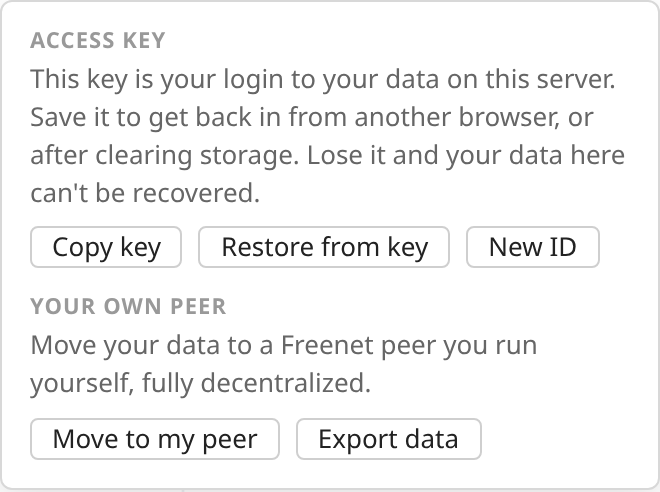
The real control, on try.freenet.org
Rules in Code, Not a Company
Every app needs rules: who can post, what's valid, who owns what. On Freenet those rules live in code anyone can verify, not on a company's server.
contract
=
the rules, as WebAssembly code (its key is a hash of that code)state
=
the app's data, and every change is signedthe contract decides
→
accept or reject each change, with no server in the loopAnd your keys never leave your device: delegates hold them locally, so no one else can act as you.
The App Ships Over Freenet, Too
Freenet doesn't just host the data. It delivers the app itself to your browser, the way the web delivers Gmail.
Open a link, the app loads
no install, no app store
No company on either side
the UI comes from Freenet, the state lives in Freenet contracts
This is optional: riverctl is a command-line client. But shipping the app this way gives Freenet the web's reach, rich apps and all, without the web's platforms.
From the apps to the engine room
Engineered Like a CPU
next: routing that learns
Routing That Learns: Renegade
Renegade is an open-source predictive model: k-nearest neighbors with a learned metric, built for flexibility and good predictions from little data, no tuning.
Freenet asks it at every hop: which peer should I ask next? It learns from real behavior, peer, contract, distance, time, and predicts who will answer, and how fast.
Learning peer × contract together catches a peer that quietly drops requests for one specific contract.
Like a CPU's branch predictor: learn the likely path, don't stall.
Open source: github.com/sanity/renegade
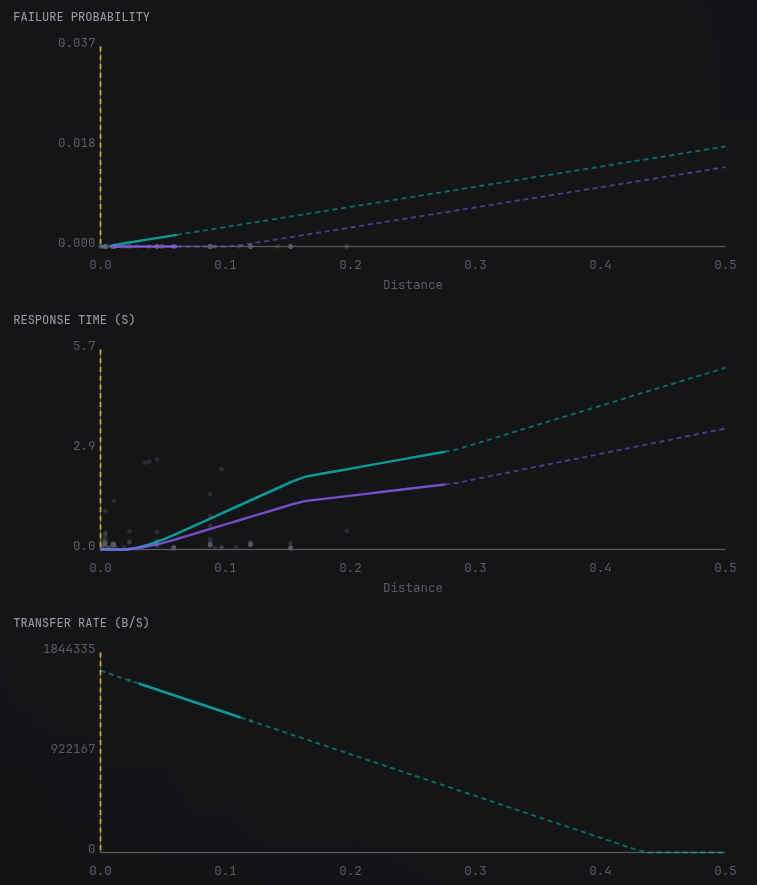
Live models, learned from real routing telemetry
What's Running Today
| App | What it is | Status |
|---|---|---|
| River | Group chat | Running, private rooms are new |
| Delta | Publishing | Running on Freenet |
| Atlas | Discovery / search | First version running |
| freenet-git | Developer tools | Working: clone, fetch, push |
Four apps you can use today. More still coming.
What's New: Private Rooms
Encrypted shared application state, hosted by a network that can't read it
Room secret
AES-256-GCM encrypts every message
Key distribution
ECIES (X25519) gives the secret to members only
Rotation
Weekly, and on every ban
Peers host and sync the room and enforce its rules, without ever reading what's inside.
What It Protects, and What It Doesn't
✓ It protects
- Message content
- Content from the peers that host the room
- Content from removed members, after rotation
✗ It does not hide
- That a room exists
- Activity, timing, and message sizes
- Membership and social-graph structure
And no Signal-style per-message ratcheting. This is shared room state with key rotation, a different design
Delta: Publishing Without a Hosting Provider
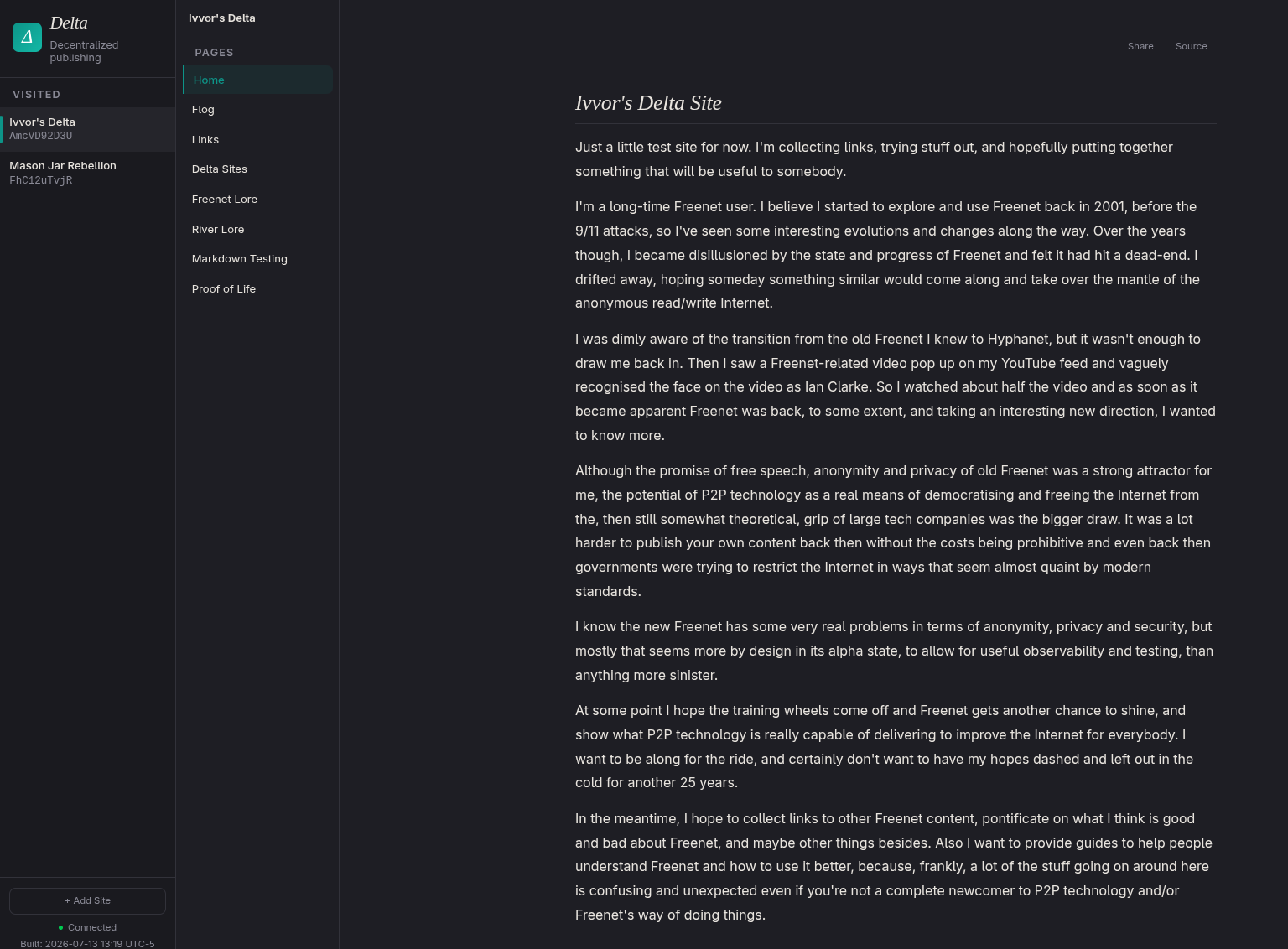
A real Delta site, published on Freenet today
Proof Freenet can host real publishing, not only chat.
a site you edit like any other
the content is a Freenet contract
nothing to pay, nothing to take down
Running on Freenet today • github.com/freenet/delta
Atlas: Discovery Without a Gatekeeper
On the web, whoever runs discovery answers to advertisers, not you.
Atlas: an open, transparent index on the network.
You pick the index and the ranking. Good defaults, never locked in.
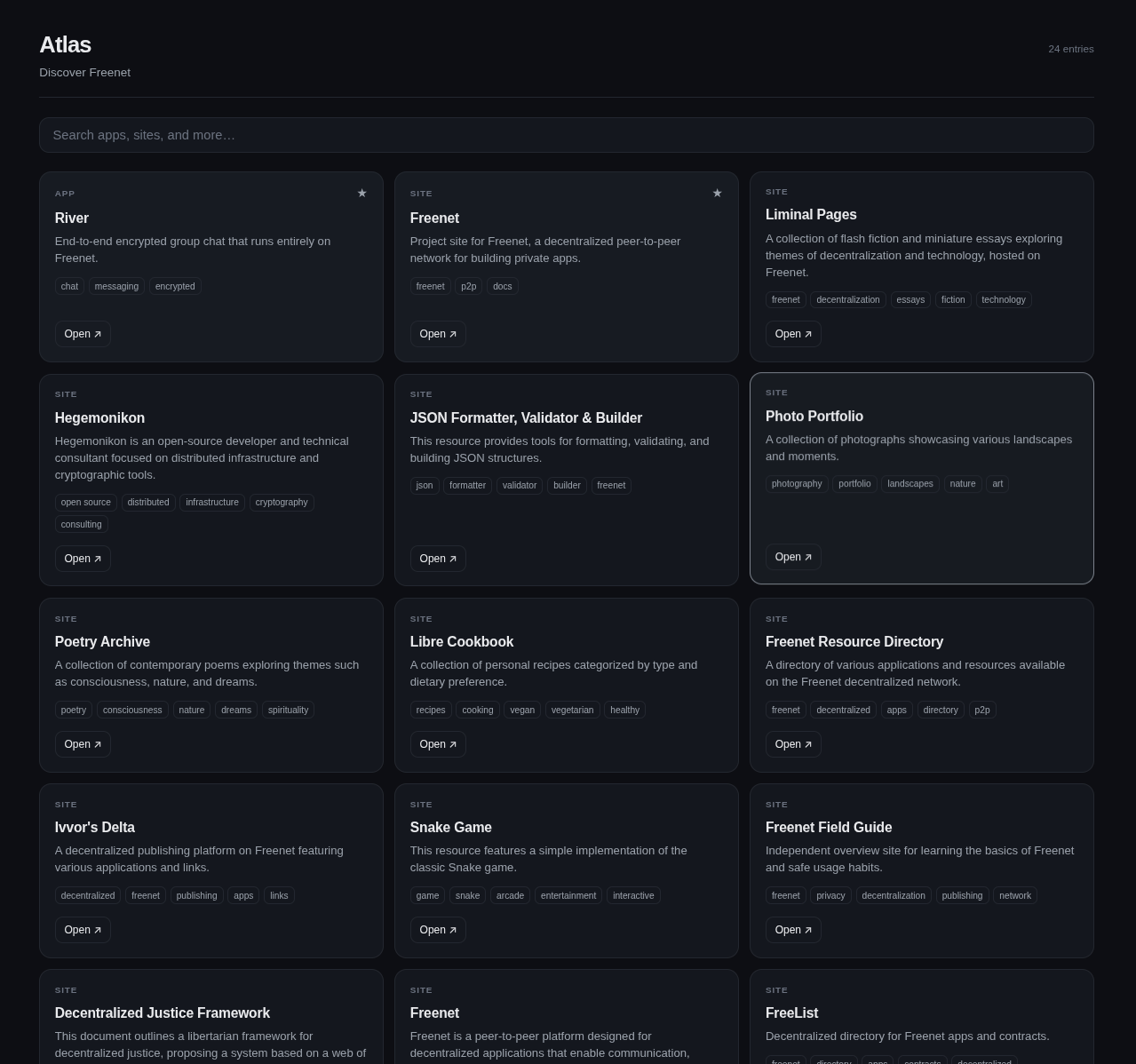
The live Atlas UI, running on Freenet today
freenet-git: Git Without GitHub
Git remains Git. What changes is where the repository lives.
# the repo is a Freenet contract, not a server you log into
$ git clone freenet::96rknpy1GYhZ/freenet-stdlib
Cloning into 'freenet-stdlib'...
==> reading repo state from Freenet
    [legacy bundle 1/4] downloading pack (31.0 KiB)
    [bundle 6]  downloading pack (734.2 KiB)
    [bundle 15] downloading pack (743.3 KiB)
    ...
==> downloaded 18 bundle(s)
==> done- Same workflow developers already know
- No account, no forge company, nothing to take the repo down
- Working today: clone, fetch, push
- A first building block for replacing GitHub: issues, reviews, CI can each be their own composable Freenet app
What's Next: Mail, Raven, Harvest

pre-alpha, deployed
Private asynchronous messaging. Post-quantum crypto. Extends Freenet from chat to email-shaped communication.
Raven
prototype
A social feed. Interesting because it stress-tests high-churn social state on Freenet.

Harvest
early design
A decentralized marketplace, like Etsy without the platform. Still design, not working software yet.
Not launch-ready. The point is that the same substrate is already taking on this many application shapes
Apps Without Platforms
River is group chat. Delta is publishing. Atlas is discovery. freenet-git is developer infrastructure. Mail, Raven, and Harvest are next.
The point isn't that Freenet has a chat app, or a publishing app, or a Git tool. It's that these are all the same pattern: applications whose backend is the network. Not a better platform. A way for applications to exist without platforms.
Try it now, no install
freenet.org/tryRun a real peer
freenet.org/quickstartQuestions?
Try it now, no install
freenet.org/tryRun a real peer
freenet.org/quickstart